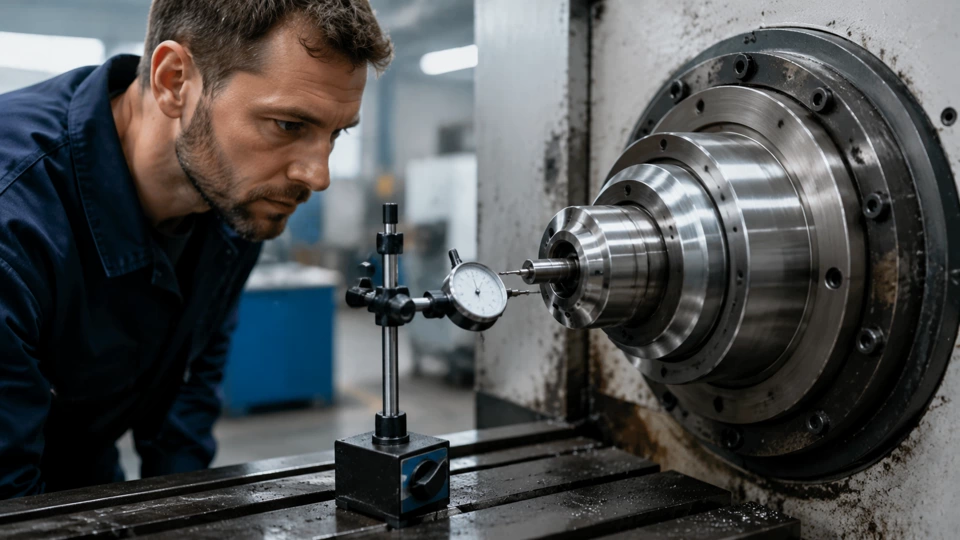
- Track runout trends over multiple shifts to separate.
- Compare radial and axial readings against machine.
- Document vibration signatures alongside dial indicator.
We noticed a gradual decline in surface finish on a horizontal machining center last quarter. The operator reported a faint chatter mark on bores that had been clean for months. Instead of jumping straight to a bearing replacement, we decided to build a runout record over two weeks. This article walks through the signals we observed, the measurements we took, and how we handed off the decision to maintenance with clear evidence.
Observed Signals on the Shop Floor
Chatter marks and thermal behavior
The first sign was a periodic chatter pattern on a 50 mm bore. It appeared only after the spindle had been running for about 45 minutes. We checked the coolant flow and found no blockage, so thermal expansion of the spindle shaft seemed likely. Over the next few days, we logged the time-to-chatter and correlated it with spindle temperature readings from the machine's thermal sensor. The pattern was consistent: once the housing reached 38°C, the marks appeared. This pointed to a possible preload change as the bearing heated up, not a sudden failure.
We also listened for bearing noise using a mechanic's stethoscope. At cold start, the bearings sounded smooth. After an hour, a low-frequency rumble emerged, especially at 3000 rpm. The rumble was not loud enough to trigger the machine's vibration alarm, but it was audible to an experienced ear. We recorded the sound level on a simple 1–5 scale each shift. The trend showed a slow increase over two weeks, from a 2 to a 3.5. This gradual change suggested wear rather than a single contamination event.
Another signal was the slight increase in spindle motor current at constant load. The CNC's load meter showed a 3% rise at 4000 rpm under the same cutting conditions. We ruled out tool wear by using a fresh end mill for the test. The extra current indicated higher friction in the bearing assembly. Combined with the chatter and rumble, we had three independent signals pointing toward bearing degradation. But we needed hard numbers before recommending a repair.
Measured Checks and Evidence Ladder
Dial indicator and vibration readings
We set up a dial indicator on the spindle taper, near the nose, to measure radial runout. The machine's original acceptance test from five years ago showed 0.0002 inches TIR. Our first reading was 0.0005 inches TIR at cold start. After a 30-minute warm-up at 6000 rpm, the runout increased to 0.0008 inches TIR. We repeated this measurement at the same time each day for ten days. The cold-start runout stayed around 0.0005 inches, but the warm runout crept up to 0.0010 inches by day ten. This thermal growth was a clear signal that the bearing clearances were opening up.
We also performed a spindle alignment check using a test bar and a height gage. The bar deflection at 300 mm from the nose was 0.0012 inches, which exceeded the machine's specification of 0.0008 inches. This misalignment could be due to bearing wear or housing distortion. To separate the two, we measured the housing temperature at four points around the front bearing. The temperature gradient was 4°C from top to bottom, indicating uneven thermal expansion. We recorded all these values in a log sheet that became part of the evidence ladder.
Vibration analysis gave us the next rung. Using a handheld accelerometer, we took readings at the spindle housing in the X, Y, and Z axes. The overall vibration level was 0.15 in/s at 1x rpm, which is within the ANSI S2.41 guideline for general machinery. However, the spectrum showed a peak at 2x rpm that grew from 0.02 to 0.06 in/s over the two weeks. That harmonic is often associated with bearing raceway waviness or preload loss. We flagged this as a secondary indicator. The evidence ladder now had three levels: operator observations, dimensional runout, and vibration signature.
Handoff Decision to Maintenance
When to repair and what to record
After two weeks of data, we had a clear trend but no catastrophic failure. The machine could still hold tolerances of ±0.0005 inches on most features, but the chatter on bores was getting worse. We decided to hand off the decision to maintenance with a recommendation to plan a bearing replacement within the next month. The evidence package included the runout log, vibration spectra, thermal data, and a summary of the observed signals. We also noted that the machine had run over 8000 hours since the last spindle overhaul, which is near the manufacturer's suggested interval.
Maintenance used our record to order the correct bearing set and schedule the repair during a planned shutdown. They also performed a final measurement of the runout after the repair, which came back to 0.0002 inches TIR cold and 0.0003 inches TIR warm. That confirmed the diagnosis. The key lesson was that a systematic runout record before bearing repair decision gave us confidence to act without rushing. We avoided an emergency breakdown and saved two days of unplanned downtime.
For other shops facing similar symptoms, I recommend starting a runout inspection log as soon as you notice any finish change. Record the date, spindle temperature, runout value, and any audible noise. Use a consistent warm-up cycle each time. Over a few weeks, the trend will tell you whether the issue is thermal drift, bearing wear, or something else. In our case, the combination of thermal growth and increasing 2x vibration was the smoking gun. We now include this evidence ladder in our Spindle Care checklist for all critical machines.
One caution: do not rely on a single measurement. Runout can vary with tool holder cleanliness, collet condition, and even the time of day. We always clean the taper with a lint-free cloth and use the same test bar for every reading. Also, check the machine's level and foundation bolts before concluding that the spindle is the problem. A soft foot can mimic bearing wear. In our facility, we follow the Ohio-based machine tool builder's guidelines for foundation stiffness, which helped us rule out external factors.
Finally, remember that bearing preload is a delicate balance. Too little preload causes chatter and runout; too much causes overheating and premature failure. Our runout record showed that the preload had likely decreased over time, allowing the balls to skid. The repair technician confirmed this when he disassembled the spindle and found polished raceways with no brinelling. The evidence ladder had guided us to the right conclusion. We now keep a permanent file of runout trends for each spindle, updated quarterly, to catch problems early.
This field diagnostic note is informational and reflects my experience as a machining process contributor. I hope it helps you make better repair decisions on your shop floor. — Lydia Park, Machining Process Contributor.
| Signal | Evidence to record | Next action |
|---|---|---|
| Initial review | Documented shop observation | Controlled next step |
For continuity, compare this inspection note with spindle care checks before setting the next maintenance window.